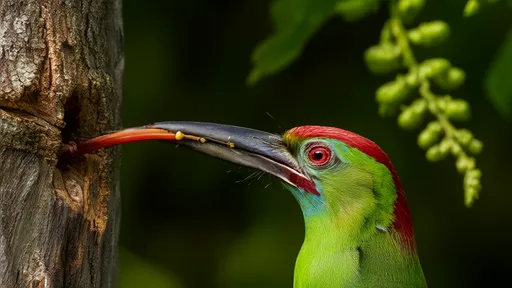
The woodpecker’s tongue is one of nature’s most extraordinary biological tools, a marvel of evolutionary engineering that allows these birds to extract insects from deep within tree bark with surgical precision. Unlike the smooth tongues of most birds, the woodpecker’s tongue is equipped with backward-facing barbs and a sticky secretion, functioning like a microscopic harpoon to snag prey. This adaptation is not just a curiosity—it’s a critical survival mechanism that enables woodpeckers to thrive in competitive ecosystems where food is often hidden beneath layers of wood.
At first glance, the woodpecker’s feeding strategy might seem brutish—hammering away at tree trunks with relentless force. But the real sophistication lies in what happens after the beak breaks through the bark. The tongue, which can extend up to three times the length of the bird’s beak, snakes into crevices with remarkable flexibility. The tip is hardened and spear-like, allowing it to probe deep into tunnels where larvae and ants retreat. Once contact is made, the barbed structure and sticky saliva ensure that prey has little chance of escape.
The secret to this efficiency lies in the tongue’s unique morphology. Unlike mammalian tongues, which rely on muscle strength alone, the woodpecker’s tongue is supported by a specialized hyoid apparatus—a bony structure that wraps around the skull, acting like a spring-loaded mechanism. This allows the tongue to shoot forward with incredible speed and retract just as quickly, minimizing the time insects have to react. The barbs, made of keratin, are sharp enough to latch onto exoskeletons but flexible enough to avoid damaging the tongue during rapid movements.
But the woodpecker’s tongue isn’t just a passive trapping device. Recent studies have revealed that the sticky saliva produced by these birds is uniquely adapted to their diet. It remains viscous enough to adhere to prey but doesn’t gum up the tongue’s barbs, ensuring that each strike is as effective as the last. This balance is crucial, as woodpeckers may strike a tree hundreds of times in a single feeding session, and any inefficiency would waste precious energy.
What’s even more fascinating is how this system varies among woodpecker species. Some, like the Northern Flicker, have longer tongues with finer barbs, ideal for extracting ants from soft, rotting wood. Others, like the Pileated Woodpecker, possess thicker, stronger tongues with more pronounced barbs, suited for prying beetle larvae from hard, dense timber. These subtle differences highlight how evolution tailors even the most specialized tools to fit specific ecological niches.
The woodpecker’s tongue also plays a role beyond feeding. During mating displays, males often use their tongues to drum against hollow wood, creating resonant sounds that attract females. The hyoid apparatus, which stores elastic energy for rapid tongue extension, also helps absorb the shock of constant pecking, protecting the bird’s brain from injury. This dual function underscores how a single adaptation can serve multiple purposes in the survival and reproduction of a species.
Understanding the woodpecker’s tongue has inspired innovations in human technology. Engineers have studied its structure to develop robotic grippers capable of retrieving objects from confined spaces, such as debris in disaster zones. The adhesive properties of the tongue’s saliva have even influenced the design of new biomedical adhesives that work in wet environments. Nature’s solutions, refined over millions of years, continue to offer blueprints for human ingenuity.
Yet, for all its sophistication, the woodpecker’s tongue is under threat. Habitat loss and pesticide use are reducing the populations of many woodpecker species, along with the insects they depend on. As forests shrink and trees become scarcer, the intricate balance between predator and prey is disrupted. Conservation efforts must consider not just the birds themselves, but the ecosystems that sustain their extraordinary adaptations.
Next time you hear the rhythmic tapping of a woodpecker in the woods, take a moment to appreciate the hidden complexity behind each strike. What seems like simple pecking is, in reality, a finely tuned operation involving biology, physics, and evolution working in perfect harmony. The woodpecker’s tongue is a testament to nature’s ability to solve problems in ways that still leave scientists in awe.

By /Aug 12, 2025

By /Aug 12, 2025

By /Aug 12, 2025

By /Aug 12, 2025
By /Aug 12, 2025

By /Aug 12, 2025

By /Aug 12, 2025

By /Aug 12, 2025

By /Aug 12, 2025

By /Aug 12, 2025

By /Aug 12, 2025

By /Aug 12, 2025

By /Aug 12, 2025

By /Aug 12, 2025
By /Aug 12, 2025

By /Aug 12, 2025

By /Aug 12, 2025

By /Aug 12, 2025
By /Aug 12, 2025

By /Aug 12, 2025
