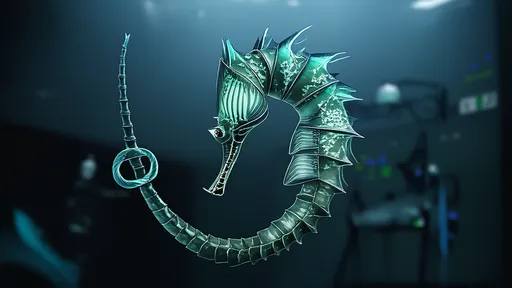
The seahorse, with its delicate and almost mythical appearance, has long fascinated marine biologists and biomechanics researchers alike. Among its many peculiarities, the prehensile tail stands out as a marvel of evolutionary engineering. Unlike most fish tails designed for propulsion, the seahorse’s tail is a versatile grasping tool, allowing it to anchor itself to seaweed, coral, or even other seahorses during courtship. Recent studies have delved into the mechanics of this unique appendage, revealing a complex interplay of muscular, skeletal, and hydrodynamic forces that enable its remarkable grip.
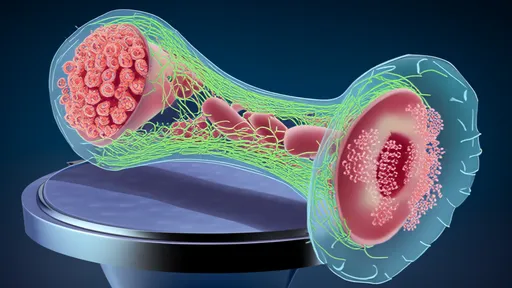
At the core of the seahorse tail’s functionality is its segmented structure. Composed of 36-40 square-like segments, the tail forms a series of articulated joints that provide both flexibility and rigidity when needed. Each segment is connected by a network of muscles and ligaments, allowing the tail to bend, twist, and coil with precision. This segmented design is reminiscent of a chainmail armor, offering protection while maintaining dexterity. Researchers have found that the square shape of these segments, rather than the more common cylindrical form seen in other species, enhances the tail’s resistance to crushing forces, making it exceptionally durable despite its slender appearance.
The gripping mechanism of the seahorse tail is a study in efficient biomechanics. When the tail wraps around an object, the muscles contract, pulling the segments tightly together. This action creates a vice-like grip, with the square edges of the segments biting into the surface for added traction. Unlike the smooth, cylindrical tails of many aquatic creatures, the seahorse’s tail maximizes friction through its textured surface, ensuring a secure hold even in turbulent waters. This adaptation is particularly crucial for seahorses, which lack the strong swimming capabilities of other fish and rely on their tails to remain stationary in fast-moving currents.
Hydrodynamics also play a significant role in the tail’s performance. The seahorse’s habitat—often dense with vegetation or coral—requires a tail that can navigate tight spaces without losing grip. The segmented design allows the tail to conform to irregular shapes, distributing pressure evenly across its length. This minimizes the risk of slippage and reduces the energy expenditure needed to maintain a hold. Interestingly, the tail’s grip strength is not constant; it can be modulated depending on the situation. For instance, during courtship, a seahorse may use a gentler grip to avoid injuring its partner, while in rough currents, it can clamp down with surprising force.
The seahorse’s prehensile tail has not only captivated scientists but also inspired innovations in robotics and materials science. Engineers are particularly interested in replicating the tail’s combination of strength, flexibility, and adaptability. Potential applications range from medical devices that can navigate delicate tissues to search-and-rescue robots capable of gripping uneven surfaces in disaster zones. By mimicking the seahorse’s tail, researchers hope to develop technologies that are both resilient and precise, much like the creature that inspired them.
Despite these advances, many mysteries about the seahorse tail remain. For example, how does the tail’s grip adjust so dynamically to different surfaces? What neural mechanisms control its intricate movements? Ongoing research aims to uncover these secrets, using advanced imaging techniques and computational models to simulate the tail’s behavior under various conditions. Each discovery not only deepens our understanding of this enigmatic creature but also opens new avenues for biomimetic design.
The seahorse’s tail is a testament to nature’s ingenuity, blending form and function in a way that continues to surprise and inspire. As scientists unravel its complexities, the lessons learned may well transcend marine biology, offering insights that could reshape fields as diverse as robotics, materials science, and even medicine. For now, the seahorse remains a master of grip, its tail a silent but powerful reminder of evolution’s endless creativity.
By /Aug 12, 2025
By /Aug 12, 2025
By /Aug 12, 2025

By /Aug 12, 2025
By /Aug 12, 2025
By /Aug 12, 2025

By /Aug 12, 2025

By /Aug 12, 2025
By /Aug 12, 2025
By /Aug 12, 2025
By /Aug 12, 2025
By /Aug 12, 2025

By /Aug 12, 2025
By /Aug 12, 2025
By /Aug 12, 2025

By /Aug 12, 2025
By /Aug 12, 2025
By /Aug 12, 2025
By /Aug 12, 2025
By /Aug 12, 2025
