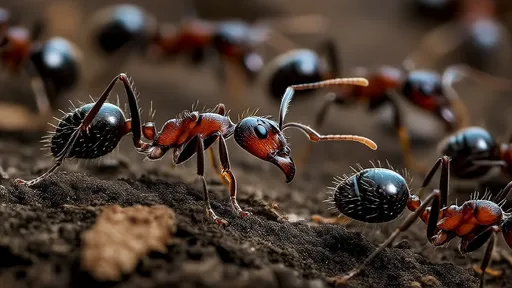
In the intricate world of social insects, few phenomena are as fascinating as the chemical communication systems that govern their collective behavior. Among these, ant colonies stand out as masterful practitioners of decentralized decision-making through pheromone trails. Recent research has unveiled remarkable insights into how these tiny creatures achieve complex logistical feats without any central command, relying instead on a sophisticated chemical language etched into their environment.
The foundation of ant communication lies in their ability to secrete and detect pheromones - volatile chemical compounds that serve as molecular messages. When a foraging ant discovers a food source, it returns to the nest while laying down an invisible trail of these chemical signals. What appears as simple instinct reveals itself upon closer examination to be a dynamic system of information exchange and collective computation.
Emergent intelligence in trail formation manifests through the interplay between pheromone deposition and environmental factors. Ants don't merely follow existing trails blindly; they contribute to an ongoing chemical conversation. The strength of a pheromone path depends not just on the number of ants using it, but on their evaluation of the route's quality. Successful foragers returning with abundant food reinforce the trail more vigorously, creating a positive feedback loop that directs more workers toward the superior resource.
This chemical communication system exhibits remarkable adaptability to changing conditions. When researchers obstruct established trails, ant colonies demonstrate an impressive capacity to collectively find alternative routes. The breakdown of the primary pheromone path triggers a spontaneous reorganization as individual ants explore new possibilities. Those discovering viable alternatives establish fresh trails, with the colony gradually converging on the most efficient new path through their cumulative chemical markings.
The evaporation rate of pheromones plays a crucial role in maintaining the system's flexibility. Unlike permanent infrastructure, these chemical signals fade over time, preventing the colony from becoming locked into obsolete solutions. This temporal dimension ensures that trails to depleted food sources naturally dissipate, freeing the workforce to pursue more productive endeavors. The balance between trail persistence and evaporation creates a self-regulating mechanism that optimizes resource allocation without requiring any individual ant to comprehend the bigger picture.
Recent studies employing microfluidic devices and computer vision tracking have revealed unexpected sophistication in ant trail dynamics. Contrary to earlier assumptions of simple stimulus-response behavior, ants appear to modulate their pheromone deposition based on multiple factors including current trail congestion, individual nutritional state, and even the type of food discovered. Some species demonstrate the ability to encode different messages through subtle variations in their chemical signatures, effectively creating distinct "dialects" for various resources or situations.
The collective decision-making prowess of ant colonies through pheromone communication holds profound implications for fields beyond entomology. Transportation engineers study these systems to improve traffic flow management, while computer scientists draw inspiration for developing decentralized algorithms. The ants' solution to complex logistical challenges - achieved without any central control or global awareness - offers a compelling model for designing robust, scalable systems in human technologies.
As research continues to decode the nuances of ant chemical communication, we gain not only deeper appreciation for these social insects but also valuable insights into the fundamental principles of collective intelligence. The humble ant's chemical trails represent one of nature's most elegant demonstrations of how simple components following basic rules can generate remarkably sophisticated group behavior through nothing more than countless local interactions mediated by molecular messages.
By /Aug 12, 2025
By /Aug 12, 2025
By /Aug 12, 2025
By /Aug 12, 2025
By /Aug 12, 2025
By /Aug 12, 2025
By /Aug 12, 2025

By /Aug 12, 2025
By /Aug 12, 2025
By /Aug 12, 2025
By /Aug 12, 2025
By /Aug 12, 2025
By /Aug 12, 2025
By /Aug 12, 2025
By /Aug 12, 2025
By /Aug 12, 2025
By /Aug 12, 2025
By /Aug 12, 2025
By /Aug 12, 2025
By /Aug 12, 2025
