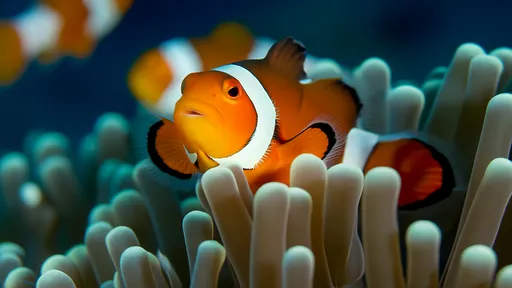
The underwater world is full of marvels that often defy human understanding, and few phenomena are as fascinating as the social and sexual dynamics of clownfish. These vibrant, orange-and-white-striped creatures, immortalized by popular culture, harbor a biological secret that has intrigued scientists for decades: the ability to change sex from male to female in response to social cues. Recent breakthroughs in endocrinology have begun to unravel the hormonal mechanisms behind this transformation, revealing a delicate interplay between genetics, environment, and physiology.
Clownfish live in highly structured social groups dominated by a breeding pair—the largest female and her male partner—along with several smaller, non-reproductive males. When the dominant female dies or is removed from the group, the largest male undergoes a remarkable metamorphosis, transforming into a female to take her place. This process, known as sequential hermaphroditism, ensures the continuity of the group’s reproductive success. For years, researchers have sought to identify the precise hormonal triggers that initiate this sex change, and new studies suggest that cortisol and androgen pathways may hold the key.
The Role of Stress Hormones in Sex Transition
One of the most compelling findings in recent research is the involvement of cortisol, a hormone commonly associated with stress responses in vertebrates. In clownfish, elevated cortisol levels appear to play a critical role in initiating the sex change process. When the dominant female is absent, the social hierarchy is disrupted, creating a stressful environment for the remaining males. This stress triggers a surge in cortisol, which in turn suppresses the production of androgens—hormones responsible for maintaining male characteristics. As androgen levels drop, the fish’s ovarian tissue, which remains dormant in males, begins to develop, setting the stage for the transition to femaleness.
Interestingly, this hormonal cascade mirrors aspects of stress responses in other species, including humans. However, in clownfish, the outcome is not pathology but a functional and adaptive transformation. The cortisol-androgen interplay acts as a biological switch, ensuring that only the most socially dominant male undergoes the change, thereby maintaining order within the group. This finely tuned mechanism highlights the evolutionary ingenuity of clownfish, allowing them to adapt swiftly to social disruptions.
Androgens and the Maintenance of Male Traits
While cortisol sets the sex change in motion, androgens—particularly testosterone and 11-ketotestosterone—are equally pivotal in regulating the clownfish’s sexual identity. In stable social conditions, these hormones sustain male physiology, inhibiting the development of ovarian tissue and promoting spermatogenesis. However, when cortisol levels rise, the suppression of androgens removes this inhibitory effect, enabling the activation of female reproductive pathways. Researchers have observed that experimental manipulation of androgen levels can either accelerate or halt the sex change process, underscoring their central role in this transformation.
What makes this system even more remarkable is its reversibility—at least in the early stages. If the social stressor is removed (for example, if a new female is introduced to the group), the transitioning male can revert to his original sex, provided the ovarian tissue has not yet fully developed. This plasticity suggests that clownfish possess an extraordinary ability to modulate their physiology in response to fluctuating social environments, a trait that may offer insights into the broader principles of sexual development in vertebrates.
Implications for Evolutionary Biology and Beyond
The clownfish’s sex-changing ability is not just a curiosity; it raises profound questions about the evolution of sexual systems and the flexibility of sex determination. Unlike mammals, where sex is typically fixed at birth, many fish and reptiles exhibit remarkable plasticity in their sexual development. Understanding the hormonal mechanisms behind clownfish sex change could shed light on how such adaptability evolved and how it is regulated across species.
Moreover, this research has potential applications beyond marine biology. The interplay between stress hormones and sexual development in clownfish may offer parallels to certain aspects of human endocrinology, particularly in cases where stress affects reproductive health. While the contexts are vastly different, the fundamental hormonal pathways share enough similarities to warrant further comparative study.
As scientists continue to decode the intricacies of clownfish biology, one thing becomes clear: these small, unassuming fish are a testament to the complexity and adaptability of life under the sea. Their ability to switch sexes in response to social cues is not just a survival strategy—it’s a window into the fluidity of nature itself.

By /Aug 12, 2025
By /Aug 12, 2025
By /Aug 12, 2025

By /Aug 12, 2025
By /Aug 12, 2025
By /Aug 12, 2025
By /Aug 12, 2025

By /Aug 12, 2025
By /Aug 12, 2025
By /Aug 12, 2025
By /Aug 12, 2025

By /Aug 12, 2025

By /Aug 12, 2025

By /Aug 12, 2025
By /Aug 12, 2025

By /Aug 12, 2025

By /Aug 12, 2025

By /Aug 12, 2025
By /Aug 12, 2025
By /Aug 12, 2025
