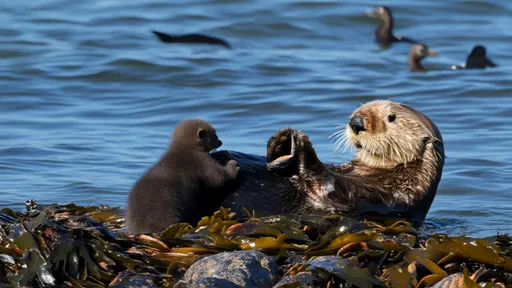
On the rocky shores of the Pacific Northwest, a remarkable educational tradition unfolds each summer. Sea otter mothers, those furry marine instructors, begin teaching their pups the delicate art of shellfish cracking - a survival skill that takes months to master. This intergenerational knowledge transfer represents one of nature's most sophisticated teaching methods, where patience and persistence triumph over instinct alone.
The classroom exists wherever the tide pools form. Mother otters select their teaching locations with care, choosing areas with abundant but appropriately sized prey for their youngsters. Unlike the brutal efficiency of adult otters that can crush urchins with a single bite, mothers demonstrate modified techniques for their pups, intentionally slowing their movements to make the process observable. Researchers have clocked mother otters spending up to 30 minutes on a single clam that would take them seconds to open when feeding alone.
Tool use education forms the cornerstone of these lessons. Sea otters are among the few mammals that consistently use tools, and this behavior isn't purely instinctual. Pups watch intently as their mothers select the perfect rock from the ocean floor - flat and about the size of a human palm. The mothers then demonstrate the proper technique: lying on their backs, placing the rock on their chests, and striking the shellfish against it with precise force. Early attempts by pups often send both rock and prey flying, prompting patient repetition from their teachers.
Nutritional weaning coincides with skill development. During the first two months of life, pups rely entirely on their mother's milk. As teaching intensifies around month three, successful shellfish cracking brings the first solid food rewards. Marine biologists have observed mothers deliberately letting pups steal partially opened shellfish from them - a calculated risk that reinforces learning through reward. The proportion of self-caught versus shared meals gradually shifts until independence.
The social aspect of this education surprises many observers. While sea otters aren't considered highly social animals, teaching moments often occur in small groups. Pups occasionally observe other mothers demonstrating techniques, suggesting a community approach to skill development. This communal learning environment may explain why sea otter tool use shows regional variations - distinct "culinary traditions" passed through generations along particular stretches of coastline.
Climate change impacts these delicate teaching relationships in unexpected ways. Warmer waters have altered shellfish distributions and sizes, forcing adaptations in teaching methods. Scientists document mothers traveling farther to find appropriate "training shellfish" - not too hard to frustrate pups, not too soft to fail to teach proper technique. The increased energy expenditure threatens both mothers and pups during this critical learning phase.
Conservationists now recognize protecting sea otter education grounds as crucial for species survival. Areas with optimal teaching conditions - the right mix of prey, rocks, and calm waters - become biodiversity hotspots. The same characteristics that support otter pedagogy also nurture diverse marine ecosystems. Marine protected areas that account for these educational needs show faster otter population recovery and more stable coastal ecosystems.
The sophistication of sea otter parenting challenges old assumptions about animal intelligence. Their teaching methods display clear markers of pedagogical intention: skill assessment, demonstration modification, and progressive difficulty adjustment. As we continue studying these marine educators, we gain not just insights into otter behavior but a deeper appreciation for the complexity of knowledge transfer in the animal kingdom. The rocks may be simple tools, but the lessons they help deliver represent an evolutionary masterpiece of inherited wisdom.
By /Aug 12, 2025

By /Aug 12, 2025
By /Aug 12, 2025
By /Aug 12, 2025
By /Aug 12, 2025
By /Aug 12, 2025
By /Aug 12, 2025

By /Aug 12, 2025
By /Aug 12, 2025
By /Aug 12, 2025
By /Aug 12, 2025
By /Aug 12, 2025

By /Aug 12, 2025
By /Aug 12, 2025
By /Aug 12, 2025
By /Aug 12, 2025

By /Aug 12, 2025
By /Aug 12, 2025
By /Aug 12, 2025
By /Aug 12, 2025
