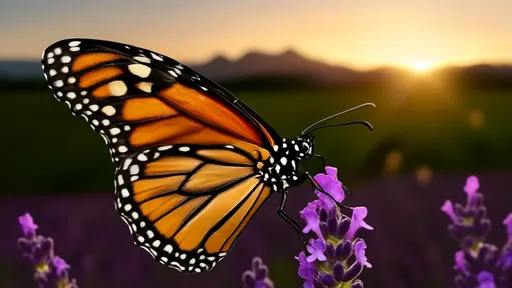
The monarch butterfly’s annual migration is one of nature’s most astonishing phenomena. Each year, millions of these delicate insects traverse thousands of miles from North America to central Mexico, a journey that spans multiple generations. What makes this feat even more remarkable is that no single butterfly completes the round trip. Instead, the migration relies on an intricate, intergenerational transfer of navigational knowledge—specifically, an inherited memory of the sun’s position in the sky, or solar azimuth. This genetic GPS system has puzzled and fascinated scientists for decades, offering a window into the complex interplay between genetics, behavior, and environmental cues.
Unlike birds or whales, which learn migration routes from their parents, monarch butterflies are born with an innate sense of direction. Research has shown that the butterflies use a time-compensated sun compass to navigate. This means they adjust their flight path based on the sun’s position relative to the time of day, a skill encoded in their DNA. The implications are profound: the butterflies inherit not just physical traits but also a behavioral blueprint for survival. This raises the question—how does a species pass down something as ephemeral as celestial navigation across generations without direct instruction?
Recent studies suggest that the answer lies in the monarch’s circadian clock genes. These genes, which regulate daily biological rhythms, appear to be linked to the butterfly’s ability to interpret the sun’s movement. Experiments involving displaced monarchs revealed that even when raised in controlled environments devoid of migratory cues, the butterflies still oriented themselves in the correct direction. This innate behavior points to a hardwired genetic mechanism, fine-tuned by evolution over millennia. The sun’s azimuth, it seems, is not just observed but remembered—not by individuals, but by the species as a whole.
The role of epigenetics—changes in gene expression rather than the genetic code itself—adds another layer of intrigue. Environmental factors, such as temperature and daylight duration during larval development, may "prime" the butterflies for migration by altering how certain genes are activated. This epigenetic tuning ensures that each generation’s internal compass aligns with seasonal shifts, even as the butterflies themselves have never experienced the journey. It’s a silent dialogue between genes and environment, a dance of adaptation written into their biology.
Human activity, however, threatens to disrupt this ancient system. Climate change, habitat loss, and the decline of milkweed—the sole food source for monarch caterpillars—are destabilizing the delicate balance that sustains the migration. Shifting temperature patterns may desynchronize the butterflies’ internal clocks from the solar cues they rely on, while deforestation in Mexico erodes their winter sanctuaries. The loss of this migration would be more than an ecological tragedy; it would erase a living lesson in how life encodes and inherits knowledge beyond the individual.
Yet, the monarch’s story is also one of resilience. Conservation efforts, from milkweed planting campaigns to protected reserves in Mexico, offer hope. Scientists studying the butterflies’ navigation have even inspired breakthroughs in robotics, where similar principles are being applied to develop autonomous drones. The monarch’s journey, etched into its genes, reminds us that nature’s solutions often surpass human ingenuity—and that preserving these wonders is as much about safeguarding knowledge as it is about saving species.
In the end, the monarch butterfly’s migration is a testament to the power of genetic memory. It challenges our understanding of inheritance, suggesting that some forms of knowledge transcend experience and reside deep within the fabric of life. As researchers continue to decode the secrets of the monarch’s compass, one thing is clear: these tiny navigators hold answers to questions we are only beginning to ask.

By /Aug 12, 2025
By /Aug 12, 2025
By /Aug 12, 2025

By /Aug 12, 2025
By /Aug 12, 2025
By /Aug 12, 2025
By /Aug 12, 2025
By /Aug 12, 2025
By /Aug 12, 2025
By /Aug 12, 2025
By /Aug 12, 2025
By /Aug 12, 2025
By /Aug 12, 2025
By /Aug 12, 2025
By /Aug 12, 2025
By /Aug 12, 2025
By /Aug 12, 2025

By /Aug 12, 2025
By /Aug 12, 2025
By /Aug 12, 2025
